Fair Trade Coffee & Global Impacts Infographic
After taking a class in Ethics and Consumption, this has been a really important topic that I feel has a lasting global impact, especially in developing countries. Many coffee farmers and producers are not paid a sustainable living wage and are often at risk due to a lack of safety regulations and overwork. That being said, it seems odd to me that, as these people are producing a product that gets most of the world through their day, they are not being paid a fair wage or being granted labor rights. To be considered a Fair Trade product, farmers and producers must follow a set of standards and become Fair Trade Certified. Fair Trade standards have many benefits besides safety and labor regulation, and Fair Trade Certification also means that producers and farmers are held to a standard that promotes sustainability and helps develop countries that are not as advanced in the modern age. Fair Trade certification does mean that coffee will become more expensive as it is funding many different efforts, but isn’t it worth it when it comes to a person’s life? I hope that this infographic provides some perspective on the global Fair Trade coffee industry and convinces coffee consumers to perhaps look into buying Fair Trade next time they purchase coffee beans.
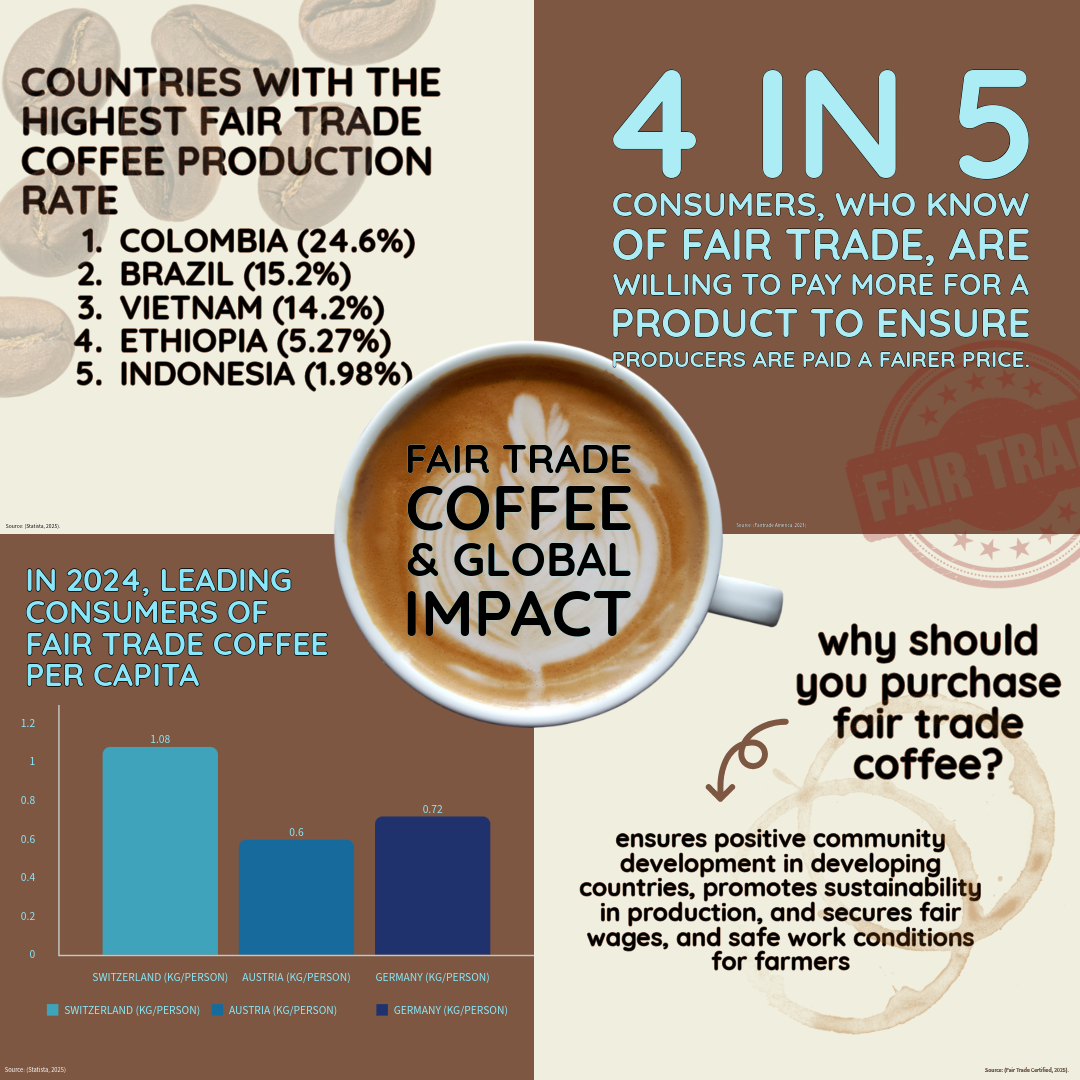
For my infographic, I chose to examine the Fair Trade coffee industry from a global perspective. I wanted this graphic to reach coffee consumers and those interested in human rights and sustainability, as its primary purpose is to inform and persuade them to buy Fair Trade coffee. This is an informational graphic that includes information about which countries produce and consume the most Fair Trade, who is buying Fair Trade, and why you should also buy Fair Trade coffee. In my infographic, I used and cited data sources from Fair Trade America, Fair Trade Certified, and Statista. I would have used more information from databases, but I felt like the information from these first-hand sources was important to include. It was also pretty difficult to find well-sourced information about Fair Trade coffee because there is not a ton of solidified information about the product, and there are a lot of concerns that are credited with Fair Trade coffee. However, the industry is becoming more prominent, and with that, I saw a lot of changes in the numbers and material I was researching from earlier to more recent articles. The dimension I used was 1x1, and the post is primarily meant for an Instagram or Social Media Platform Post. I also used Adobe Express to create my infographic.